Rinn Artificial Intelligence and Fraunhofer launch European initiative to advance next-generation of data spaces
New strategic research collaboration; launched as part of the European Big Data Value Forum 2026, will address trusted, sovereign and interoperable data sharing across sectors and support Europe’s future competitiveness in AI
Rinn Artificial Intelligence and two leading Fraunhofer institutes in Germany formally launched a new strategic European research collaboration, to develop the next generation of trusted and interoperable data spaces, at the European Big Data Value Forum at Dexcom Stadium, Galway.
The Next Generation Dataspaces Initiative (NGDI): Enabling the Future of European Cross-Domain Data Spaces brings together Rinn Artificial Intelligence, the Fraunhofer Institute for Applied Information Technology FIT and the Fraunhofer Institute for Software and Systems Engineering ISST.
Established through Fraunhofer’s International Cooperation and Networking (ICON) programme, NGDI brings together expertise in data spaces, artificial intelligence, large language models, knowledge graphs, agentic AI, data governance, interoperability and digital technologies to address a growing challenge for Europe: how to enable trusted, sovereign and interoperable data sharing across sectors, organisations and data spaces.
Europe has made significant progress in developing sector-specific data spaces. NGDI will focus on the next challenge of enabling these ecosystems to work together. Future applications of data and AI will increasingly depend on the ability to discover, access, combine and use trusted data across organisational and sectoral boundaries while preserving sovereignty, governance, security and control.
The initiative comes as Europe develops Common European Data Spaces, advanced data infrastructures and increasingly interconnected data ecosystems. Access to trusted and interoperable data is expected to become a fundamental component of Europe’s capacity to develop and deploy competitive AI systems.
Professor Edward Curry, Rinn Artificial Intelligence, University of Galway, said:
“Europe’s next digital challenge is to move from a collection of individual data spaces to an interconnected European data ecosystem. The success of Common European Data Spaces will ultimately depend on their ability to share and combine trusted data across sectors and organisational boundaries, while maintaining the sovereignty, security and control of those who contribute it.
This is essential for the future of AI in Europe. The next generation of AI will not only depend on powerful models, but on the ability to access diverse, high-quality and trusted data. NGDI brings together complementary European research strengths to address this challenge and help create the technological and governance foundations for data spaces that can interoperate at scale. In doing so, we have an opportunity to shape a European model of data and AI that is innovative, trusted and sovereign.”
Professor Stefan Decker, Fraunhofer Institute for Applied Information Technology FIT, said:
“The development of trusted cross-domain data ecosystems will be fundamental to Europe’s digital future. NGDI creates an opportunity to combine complementary expertise from Ireland and Germany to explore not only the technologies required to connect data spaces, but also the governance and processes necessary to make those connections trusted, sovereign and useful.
Our ambition is to create foundations that can ultimately move beyond the research environment and support practical applications across European industry and society.”
The collaboration combines complementary research strengths. Rinn AI contributes expertise in data spaces, knowledge graphs and linked data; Fraunhofer FIT brings expertise in digital spaces, digital self-determination and the application of AI to digital business processes; and Fraunhofer ISST contributes expertise in sovereign and value-creating data spaces, cross-domain architectures, technologies and governance principles.
Professor Boris Otto, Fraunhofer Institute for Software and Systems Engineering ISST, said:
“Common European Data Spaces will only realise their full potential if they can operate as part of a wider, interconnected data ecosystem. NGDI addresses this important next step by exploring how data spaces across different sectors and domains can securely and reliably exchange and combine data while preserving the sovereignty and control of the organisations that contribute.
By developing the architectures, governance approaches and technological foundations needed for trusted cross-domain data sharing, NGDI can help provide an important building block for the evolution of Europe’s Common European Data Spaces. Our ambition is to ensure that these spaces do not remain isolated ecosystems, but can become part of a genuinely interoperable European data infrastructure capable of supporting innovation and AI at scale.”
Professor Noel O’Connor, Director of Rinn Artificial Intelligence, said:
“Europe’s ability to compete in Artificial Intelligence will increasingly depend on its ability to access and use high-quality, trusted data. We have made considerable progress in developing data spaces within individual sectors; the opportunity now is to enable those data spaces to work together, allowing data and AI to create value across traditional organisational and sectoral boundaries.
NGDI is an important opportunity for Rinn AI to combine our expertise with that of Fraunhofer FIT and Fraunhofer ISST to address this challenge at European level. It also demonstrates the strength of the research capability that Ireland can bring to major European collaborations in AI and data, and our ambition to translate that research into innovation and impact for enterprise and society.”
Dr Stephen O’Driscoll, Research Ireland, said:
“Ireland’s future competitiveness will depend on our ability to build world-class research capability at home while connecting that expertise to the strongest international research and innovation networks.
The Next Generation Dataspaces Initiative is an excellent example of that ambition in practice. By bringing together leading Irish and German expertise to address some of the fundamental challenges around data, AI, interoperability and digital sovereignty, this collaboration can strengthen Ireland’s contribution to Europe’s research and innovation ecosystem while creating new opportunities for economic and societal impact.”
Through NGDI, the partners aim to develop new governance models, technological building blocks and processes that can support the evolution towards next-generation data spaces. A central objective is not only to advance scientific knowledge, but also to translate research outcomes into practical and commercial applications that can generate value for industry and society.
The initiative will be formally launched at the European Big Data Value Forum 2026 in Galway. The launch session will include Professor Stefan Decker, Stephan O’Driscoll of Research Ireland, Professor Noel O’Connor and Professor Edward Curry, followed by research highlights from the initiative.
Dr Diego Collarana, Fraunhofer Institute for Applied Information Technology FIT, said:
“While existing data space initiatives focus primarily on basic hosting and infrastructure plumbing, the ICON-NGDI project aims to bring Agentic AI to the core of dataspaces as an essential cognitive automation layer. By pairing the natural-language flexibility of Large Language Models (LLMs) with the deterministic precision of Knowledge Graphs (KGs), this Neuro-Symbolic AI framework will transform static data sharing into dynamic, automated, trust-verified asset exchange across heterogeneous domain ecosystems.
Embedding these autonomous AI agents directly into the interoperability layer shifts the operational burden away from manual engineering and legal compliance bottlenecks. By automatically harmonising complex cross-domain data schemas and dynamically detecting semantic contradictions in usage contracts, Agentic AI unlocks the full potential of scalable, sovereign cross-sector collaboration.”
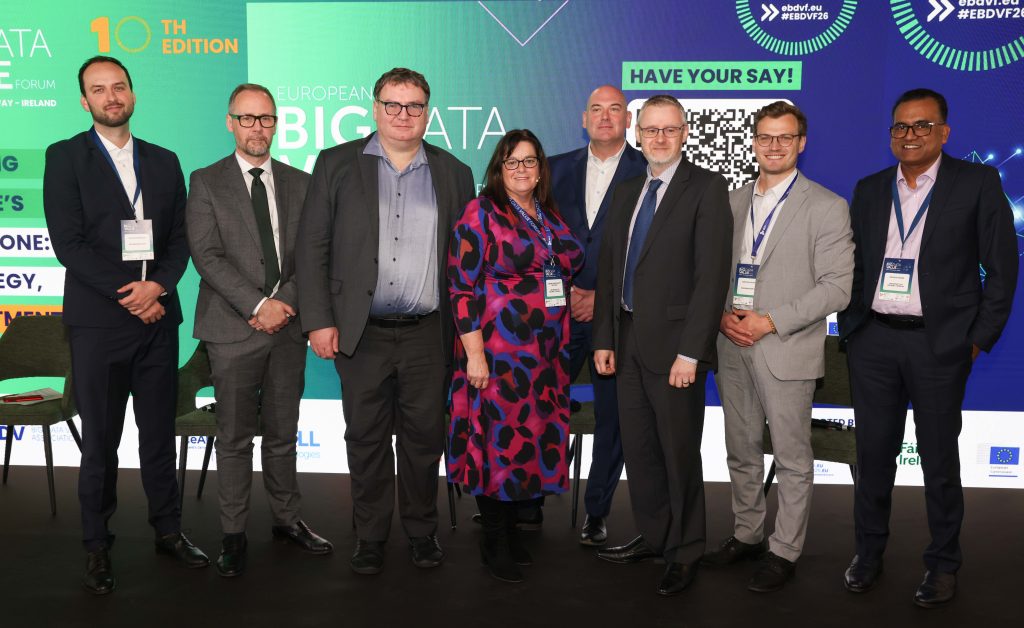
Image caption: Maik Mannsfeld, Fraunhofer ISST; Dr Stephen O’Driscoll, Research Ireland; Prof. Stefan Deckar, Fraunhofer FIT; Carmel McGroarty Mitchell, Rinn AI; Prof. Noel O’Connor, Rinn AI; Prof. Edward Curry, Rinn AI; Dr Joshua Gelhaar, Fraunhofer ISST & Dr Rafiqul Hague, Rinn AI.